Who Fills the Dover-Sized Hole?
Nobody. That's the opportunity.

Dover Saddlery doesn’t have to formally close for the damage to be real.
Seven stores are already confirmed gone. California, Michigan, and Massachusetts will have no Dover presence by the time the July deadline hits. The headquarters in Littleton is operating under a WARN Act notice. The WEC Ocala flagship, announced last June as a symbol of Dover’s next chapter, is still under construction and almost certainly never opens.
The shelf is already getting smaller. The question the industry needs to answer isn’t whether Dover survives. It’s who picks up what Dover drops.
The honest answer is: nobody fills it whole. The Dover-shaped hole is actually three different holes. And they are going to be filled, if at all, by three very different players solving three very different problems.
What Dover actually was
Before you can map who fills the vacuum, you have to be precise about what Dover actually served.
Layer one: utility supply. Blankets, basic tack, barn essentials, everyday consumables. The rider who needs fly spray and a spare girth and doesn’t want to wait a week for shipping.
Layer two: the expertise layer. Not just assortment. Curation, context, and a fitting room staffed by someone who actually rides. The adult amateur who calls the 800 number and gets a real answer. The rider who doesn’t know which bit to try next and trusts that the person on the floor does. That relationship is what Dover’s retail model was built around, and it is genuinely hard to replicate.
Layer three: the aspirational layer. This one requires honesty. Dover used to be here. Founded by elite equestrians, built on deep product knowledge and real community, it carried genuine identity weight in its early years. But read the comments on any Dover post from the last several years and the story is clear: the aspiration had been draining out for a long time. The PE ownership cycles, the SKU rationalization, the drift toward an undifferentiated assortment. Dover stopped feeling like a destination well before it started closing stores.
So the aspirational layer isn’t just unclaimed. It’s undefined. Nobody has figured out what an aspirational English equestrian retailer looks like at scale in the US, including Dover.
Layer one: already spoken for
The utility transition is largely done, and it happened before Dover filed a single WARN notice.
Tractor Supply’s 2,270-plus store footprint has owned commodity equine supply for years. Feed, wormer, basic barn essentials. The Allivet acquisition moves them further up into Rx. You are not going to out-TSC Tractor Supply on utility supply.
Chewy acquired SmartEquine (formerly SmartPak) in November 2025 and called equestrian “passionate and underserved” in the same breath. Before that deal closed, SmartEquine had already struck an agreement making Tractor Supply the exclusive national brick-and-mortar retailer for SmartPaks. The two largest players in the utility layer quietly wired themselves together before Dover’s WARN Act notice was ever filed.
Amazon belongs here too. The search behavior tells you everything: riders finding equestrian product on Amazon are typing category terms. Blankets, bits, fly spray, girths. That is commodity search, not curated discovery. Schneiders has a full Amazon storefront. Professional’s Choice has one too. More brands will follow.
Amazon drives volume. Your dot com drives margin. Running both isn’t a contradiction. It’s a strategy. The brands building Amazon presence in Dover’s absence aren’t panicking. They’re being smart.
For the utility layer customer, the replacement infrastructure already exists. It just isn’t called Dover.
Layer two: the expertise gap, and an open question
This is where Dover’s absence does the most damage.
The rider who wants edited assortment, knowledgeable staff, a context-aware recommendation, and a fitting room for tall boots has no obvious national home.
Independent tack shops will absorb local share, but only if they go get it. This is a critical distinction. The riders who just lost their nearest Dover are not going to find their local tack shop through word of mouth alone. Most independent tack shops have minimal SEO presence, no meaningful digital marketing, and no infrastructure for capturing customers who are actively looking for a new home. The opportunity is real. The ability to passively receive it is not. Shops that want Dover’s displaced customers will need to actively pursue them: search optimization, digital visibility, and the ability to show up when a rider types “English tack shop near me” into Google for the first time.
In the US, multi-location independent tack shop operators are rare enough to count on one hand. Farm House Tack runs three locations, all anchored to major equestrian venues: Tryon, WEC Ocala, and their Landrum, South Carolina flagship. Mary’s Tack and Feed in Del Mar, California is a 12,000-square-foot superstore with a strong national online presence and one location. Schneiders, operating since 1948 out of Chagrin Falls, Ohio, is primarily a catalog and online player now. That’s the landscape. Three locations is the ceiling for any US independent tack operator.
There is also a question worth asking out loud: if the expertise layer isn’t being rebuilt by a retailer, could it be rebuilt by something else? The growth of AI-powered search and agentic tools is already changing how people navigate complex product decisions in specialty categories. Nobody has seriously asked yet whether the next answer to “what bit should I use” comes from a person, a store, or a model. That question is coming for equestrian the same way it’s coming for every specialty category. It doesn’t solve the physical retail problem. But it complicates the assumption that expertise has to live in a store at all.
Layer three: what does aspirational even look like?
This is the most interesting and most unresolved question in the room.
The aspirational English equestrian rider has always been underserved in the US. What does a retailer actually built for her look like?
In Europe, there are answers. PADD has operated since 1974 as France’s dominant equestrian retailer, with 100 stores across Europe and more than 12,000 product references. It has an aesthetic. It has a point of view. It feels like somewhere. PADD now has a US e-commerce presence, and the model it represents is worth studying closely. More on PADD and the European retail structure in a forthcoming piece.
In Canada, Greenhawk built what the US never produced: 50-plus locations, a national franchise network, catalog, e-commerce, and a family ownership structure that has held for 40 years. I wrote about Greenhawk and what it tells us about the US market here. The timing of their US expansion is worth noting: they opened a physical store in Natick, Massachusetts and launched a US e-commerce site last year. They are planting a flag in Dover’s home state at the exact moment Dover is pulling out of it entirely.
In the US, the closest aspirational approximation at the individual level is a shop like Manhattan Saddlery: a specific location, a specific sensibility, a community that forms around it. Not a chain. Not a catalog. A place.
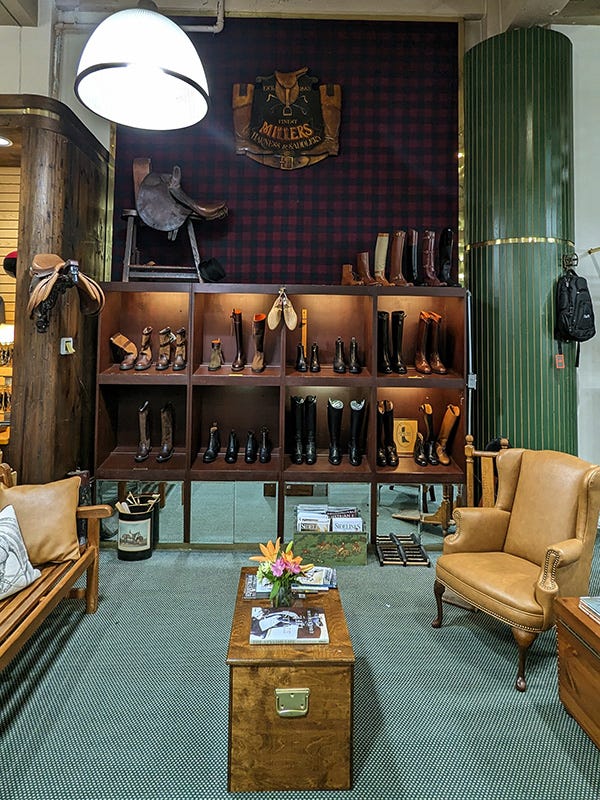
That may be the right unit of measure for the aspirational layer right now. Not a national brand, but independent shops with genuine points of view, each serving a specific community with real depth.
The aspirational layer of US equestrian retail was never really solved. Dover’s decline doesn’t create that problem. It just makes it impossible to ignore.
What the brands already know
The brands that supplied Dover are not waiting for a replacement. They are building their own channels because they have to.
State Line Tack got absorbed by PetSmart and took the customer relationship with it. The brands that watched that happen are not making the same mistake twice. Schneiders and Professional’s Choice both have Amazon storefronts. More will follow. The smart brands are running Amazon for volume and their own sites for margin, building direct customer relationships that no longer depend on any single retailer staying solvent.
That is a healthy response. It is also a structural acknowledgment that no one is coming to rebuild what Dover was.
The honest map
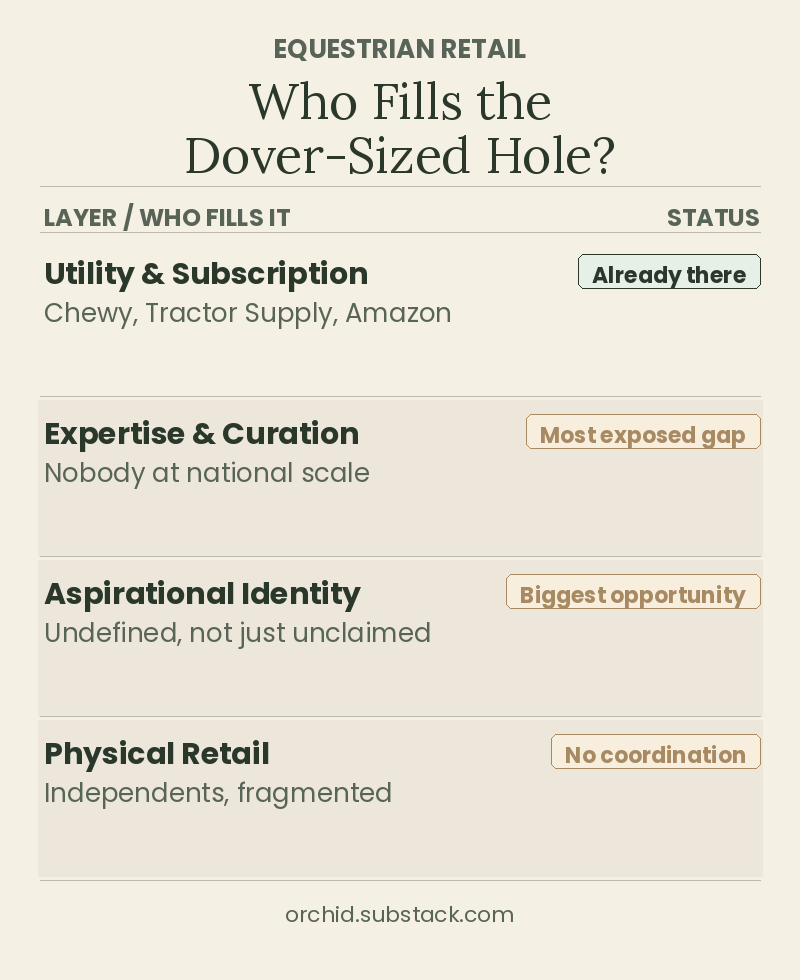
The Dover-sized hole doesn’t get filled. It gets divided among players each optimized for a piece of it, leaving the most valuable layer, the customer who cares about equestrian as an identity, in a market that still doesn’t know what to build for her.
That has been the structural condition of this industry for a long time. Dover’s decline just makes it impossible to ignore.
A note on the numbers. Dover figures (store count, WARN Act filing, July closure timeline, headquarters employee count) are drawn from the Massachusetts WARN Act notice filed May 7, 2026, reported by the Boston Globe and Chronofhorse. Chewy revenue ($12.6B, FY2025) and SmartEquine acquisition (November 2025) are from Chewy’s public earnings filings and acquisition announcement. Tractor Supply store count (2,270-plus) is from TSC’s most recent annual report. PADD store count (100, Europe) and founding date (1974) are from EKKIA Group’s website and paddtack.com. Greenhawk location count (50-plus) and Natick store opening are from the May 2025 Plaid Horse press release and us.greenhawk.com. Farm House Tack location count (3) is from farmhousetack.com. Mary’s Tack square footage (12,000) is from marystack.com. Schneiders founding date (1948) is from sstack.com.
Orchid Bertelsen is an equestrian industry analyst and consumer marketing strategist with 20 years of experience in e-commerce and brand strategy. She rides at Grosse Pointe Equestrian in Michigan.
This piece builds on Dover Saddlery Update: What’s Confirmed, What It Means, and What I’m Watching (May 10, 2026) and Has Private Equity Broken Dover Saddlery? (April 2026).
I love what you said about Amazon supporting the volume and their site driving margin. It’s so sad to see these national brands I grew up with slowly disappear, but with the constantly changing technology and environment, consumers show up so differently. I think a lot of smaller brands are trying to tackle the aspirational side of things. KBMedia/adult amateur podcast just talked about how media for our sport is so different from more commercial sports - and I think this influences the way aspirational retail shows up for equestrians, too.
Very interesting analysis and completely true! Those of us who remember Beval Saddlery will see that as a business that filled number three. They had two very successful brick and mortars with strong community ties. A successful mail order/website business, an 800 number staffed by knowledgeable equestrians, a wholesale business with 350 dealers and a third location at Wellington during the season. If someone could duplicate that they would be in the right track.