Not Just a Tack Shop: What PADD Is Actually Building in the US
The model US equestrian retail has never seen.

PADD opened in Wellington. Most American riders have never heard of it.
That is worth understanding.
The store at 29 S H Street in Lake Worth Beach, Florida sits minutes from the Palm Beach International Equestrian Center, the winter home of the most competitive equestrian circuit in the United States. It opened quietly. No press release. No trade coverage. No announcement.
It is not a tack shop that decided to expand. It is the US foothold of something that does not yet have an American equivalent.
The Origin
The first PADD store opened in 1974 on rue de la Cavalerie in Paris’s 15th arrondissement. Three founders: Pierre, André, and Denis. The address translates to Cavalry Street.
A small Paris shop for horse people, on a street named for horses, that became France’s dominant equestrian retailer over the next 50 years.
By 1995 the group had opened its first large-format store at 360 square metres. The first franchised location followed in 2008. Today the network spans 40 corporate stores and 54 franchised locations across France.
PADD is not an independent retailer. It is the retail arm of EKKIA Group, a company founded in 1967 in Haguenau, Alsace, that describes itself as Europe’s leading brand platform for horse and rider equipment. Understanding what EKKIA actually does is the only way to understand what PADD’s US entry actually means.
The Structure
Most equestrian retailers do one thing: they buy brands from wholesalers and sell them to riders. The margin they capture is the spread between the price they pay and the price the rider pays.
That is the entire business model. It is the model Dover Saddlery, Greenhawk, and every independent tack shop in the United States operates on. It is also, as I have written previously, the core structural reason US equestrian retail has a gap that has never been filled.
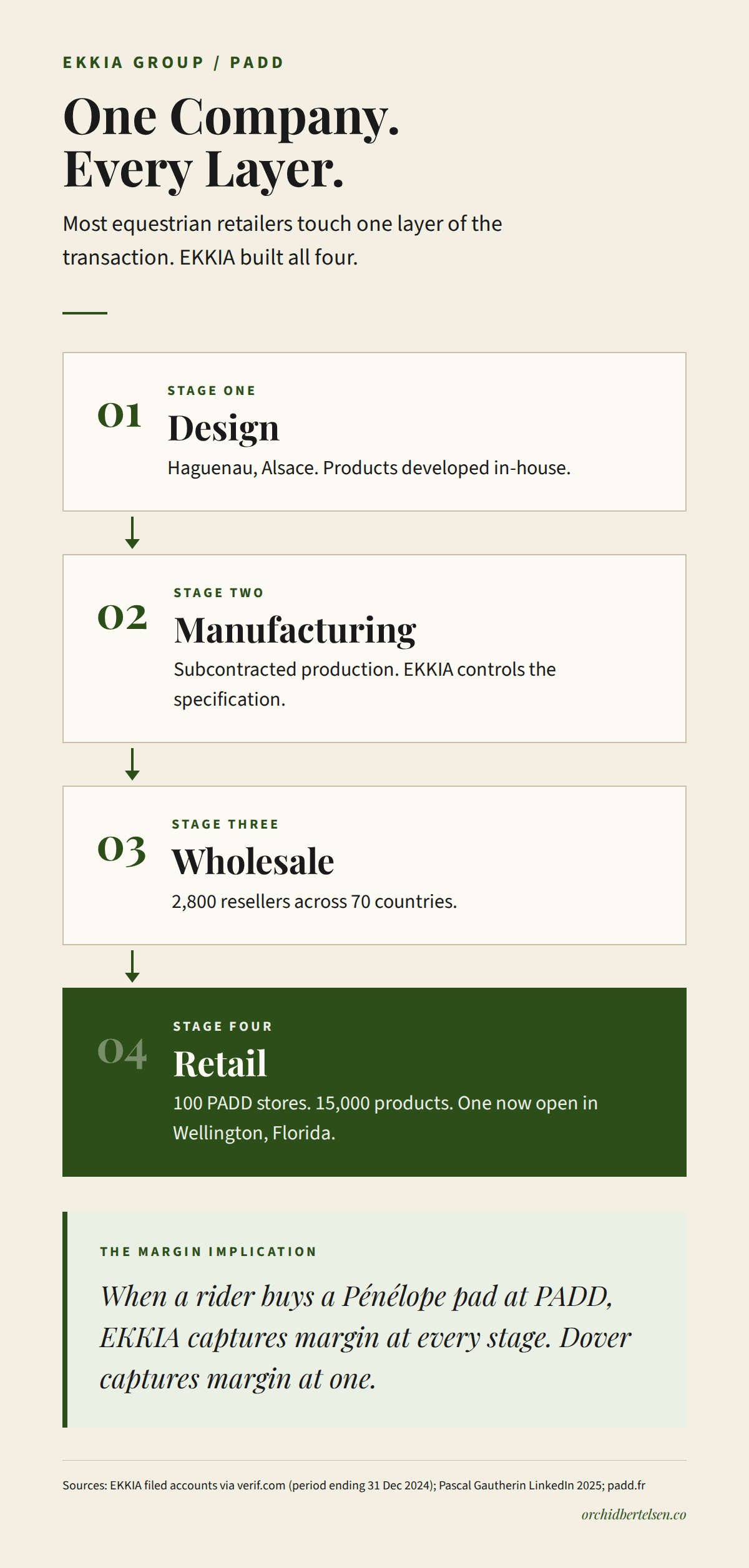
EKKIA Group operates differently.
EKKIA designs its products in Alsace, uses subcontracted manufacturing, and distributes wholesale to 2,800 resellers in 70 countries. It also retails those same products through 100 PADD stores carrying 15,000 products from hundreds of brands, including but not limited to its own.
PADD is not a brand store. It is a multi-brand specialist retailer. A PADD store carries Samshield, Horseware, Kentucky, Uvex, and EKKIA’s own labels alongside each other. EKKIA competes with those brands wholesale and sells them retail. That combination does not exist in US equestrian.
The financials are public. EKKIA’s accounts, filed with the French commercial registry, show revenue of €61,626,552 and net profit of €8,476,083 for the period ending 31 December 2024. That is a 13.7% net margin on a business that designs, wholesales, and retails across 70 countries.
These are not estimates. They are filed accounts.
The Pénélope Case Study
The clearest way to see how EKKIA’s model works is through the Pénélope brand.
In 2018, EKKIA signed a licensing agreement with Pénélope Leprévost, the French Olympic equestrian champion, for the apparel brand she co-founded. EKKIA renewed that license in 2021 for 12 years. Under EKKIA’s management, the brand grew from 25 products to 250.
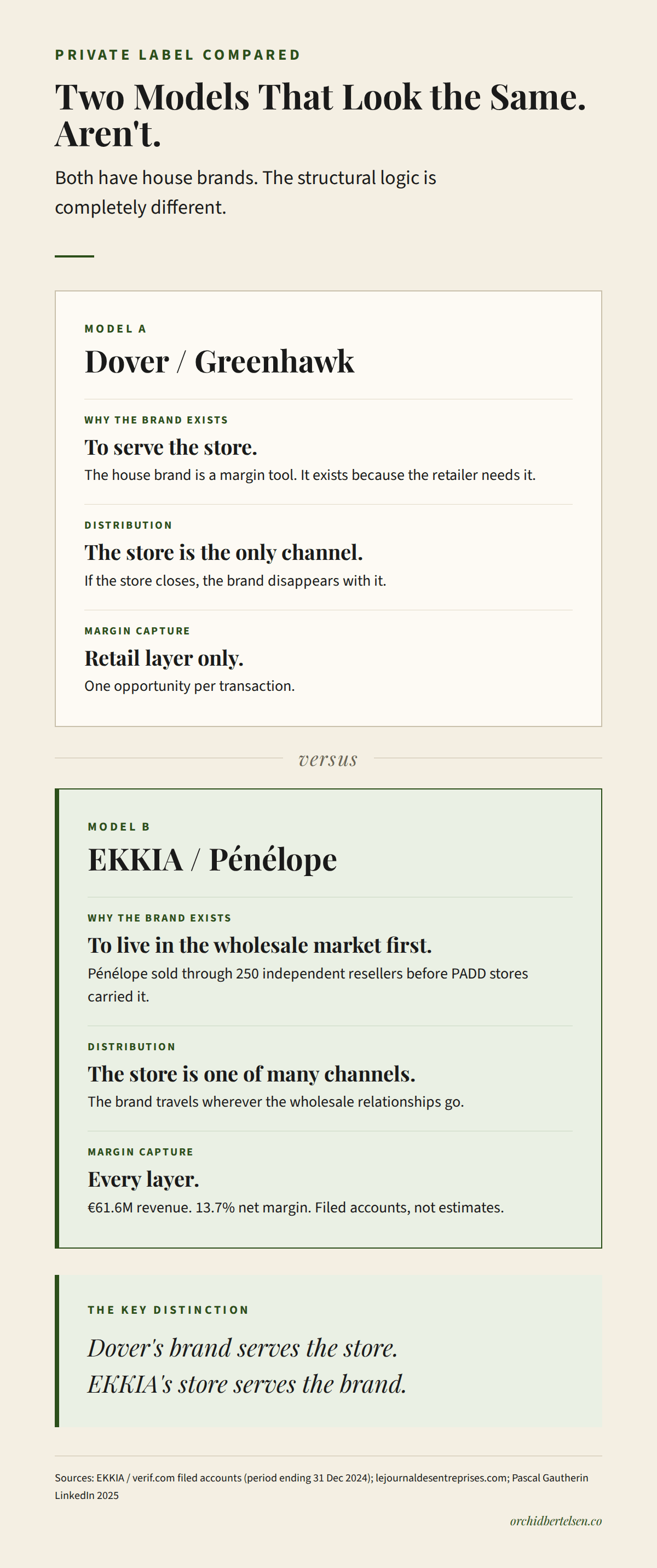
Pénélope sells through PADD stores. It also sells through 250 independent resellers in France and internationally. The brand has a wholesale life entirely separate from the PADD retail network.
This is the structural distinction that separates EKKIA from the house brand strategies at Dover or Greenhawk.Dover’s private label and Greenhawk’s house brands exist to serve the store. They are margin tools for a retailer. EKKIA inverts the relationship.
The brand exists in the wholesale market first. The store is one of many distribution channels, not the reason the brand exists. The practical implication for the US is significant: EKKIA can seed brand demand through US wholesale accounts before a single additional PADD store opens. The retail follows the brand.
The Leadership
Pascal Gautherin has served as President of EKKIA since 2018. Before taking the group presidency, he ran the PADD store network directly. He understands the retail operation from the inside.
In a 2022 interview, he described EKKIA’s position: “Apart from cycling, a shop specializing in a single sport like ours doesn’t exist in France.” The strategy he describes is cross-channel: wholesale relationships that create demand, retail locations that capture it, e-commerce that extends reach beyond physical footprint.
In 2025, Gautherin opened EKKIA’s capital to employees. Today, 100% of EKKIA’s team members are shareholders.That is not a standard move for a company optimizing for a near-term exit. It is the kind of decision a builder makes.
The US Entry
EKKIA listed the opening of its US operation as one of its 2025 milestones. The US operation is paddtack.com, with a US-based team managing the site and fulfilling orders domestically.
The physical retail piece is quieter. A store previously operating as Riderzon Equestrian at 29 S H Street in Lake Worth Beach now operates under the Paddtack brand. The phone number and address are unchanged. The Facebook page confirms the rebrand: “Riderzon.com becomes paddtack.com.”
No press release. No trade coverage. No announcement.
Why Wellington
Lake Worth Beach sits five to ten miles from the Palm Beach International Equestrian Center in Wellington, Florida. Between January and April, the Winter Equestrian Festival and the Global Dressage Festival draw the most competitive riders in the country to that geography. It is the most concentrated equestrian market in the United States during the winter season.
If you are introducing a brand to US equestrian consumers, there is no better room to be in. EKKIA chose the right room.
The e-commerce and physical retail combination also reflects how EKKIA operates in France: brand awareness first, retail presence to capture and amplify demand. Paddtack.com serves the national market. The Lake Worth Beach store serves the show circuit.
What Does Not Transfer
EKKIA’s position in France rests on 50 years of brand equity, an official partnership with the Fédération Française d’Equitation, and deep relationships with riders at every level of the sport. None of that crosses the Atlantic automatically.
Pénélope Leprévost is a three-time Olympic champion. She is largely unknown to American riders. The brand recognition that drives traffic to PADD stores in France has to be built from scratch here.
LeMieux has already staked the premium European import position in the US market, with audited revenues of £51.7 million for the year ended April 2024 and 40% year-on-year growth in North America. The European brand category is not uncrowded.
Building from a single rebranded store in Lake Worth Beach to meaningful national presence is a long road.Structural advantages do not guarantee execution.
The So-What
The US equestrian market has never had what PADD represents: a company that owns the brands and owns the multi-brand retail network that sells them. It has had retailers. It has had brands. It has had wholesalers. It has not had a single entity doing all three simultaneously, at scale, in a purpose-built specialist equestrian context.
That model exists in France. It has produced 100 stores, 2,800 wholesale resellers in 70 countries, €61.6 million in annual revenue, and a 13.7% net margin. It is now in Wellington.
Whether EKKIA can translate that infrastructure to the US market is genuinely unknown. The structural conditions that made PADD dominant in France do not exist here in the same form. The US is larger, more fragmented, and more competitive.
But the company that just arrived in Lake Worth Beach is not a retailer looking to open a few stores. It is an operator with a manufacturing-to-shelf model the US market has never encountered.
Understanding what it is matters, because whether it succeeds or stumbles, it is going to change something about how equestrian retail works here.
A Note on the Numbers: EKKIA’s revenue and profit figures are from publicly filed French accounts submitted to the Registre du Commerce et des Sociétés, accessed via verif.com, for the period ending 31 December 2024. Reseller count, store count, and employee shareholder information are from Pascal Gautherin’s 2025 LinkedIn year-end recap. LeMieux revenue is from LDC’s published portfolio page. The PADD franchise structure is from the lexpress-franchise.com listing. The Riderzon-to-Paddtack rebrand is sourced from the Paddtack Facebook page, with address and phone number confirmed via Yelp. Primary sources are linked inline throughout.
Orchid Bertelsen is an equestrian industry analyst and consumer marketing strategist with 20 years of experience in e-commerce and brand strategy. She rides at Grosse Pointe Equestrian in Michigan.