The Exit Desert
What PE actually is and why equestrian brands keep taking it


You have spent twenty years building something. The product is real. The community trusts it. The brand has accumulated something that took decades to earn and cannot be replicated quickly. And you are approaching the moment where you want some of what you built back.
What are your options?
This is the question the equestrian community almost never discusses. The conversation about private equity focuses almost entirely on outcomes: a beloved brand changes, a retailer closes, a founder’s name stays on a label that no longer belongs to them.
What it rarely focuses on is why founders make the decisions they make. Why they take the money. Why they sometimes have almost no other choice.
To understand that, you need to understand two things: how private equity actually works, and how thin the exit market for equestrian brands actually is.
What Private Equity Is
A private equity fund is not a company. It is a contract.
A PE firm raises capital from institutional investors: pension funds, endowments, family offices, and high-net-worth individuals. It commits to deploying that capital into portfolio companies within a defined time window. The fund has a fixed life, typically ten to twelve years.
Capital is deployed in the first few years, companies are held and grown in the middle years, and proceeds are returned to investors in the final years. That clock is built into the fund’s founding documents as a legal obligation to investors.
Returns are generated by buying a company at one multiple of earnings, improving those earnings during the hold period, and selling at a higher multiple. Leverage, borrowed money used to fund part of the acquisition, amplifies returns on the way up and risk on the way down.
The incentive that runs through every decision in a PE-backed company is the exit. Not the product. Not the customer. Not the fifty-year health of the brand. The exit multiple, on a fund timeline. Those are genuinely different objectives, and every decision the fund makes follows from that difference.
The structure produces the outcome. Predatory intent is not required. A PE fund that ignored its exit obligation would be failing its own investors. Understanding that is what separates useful analysis from moral outrage.
The Exit Desert
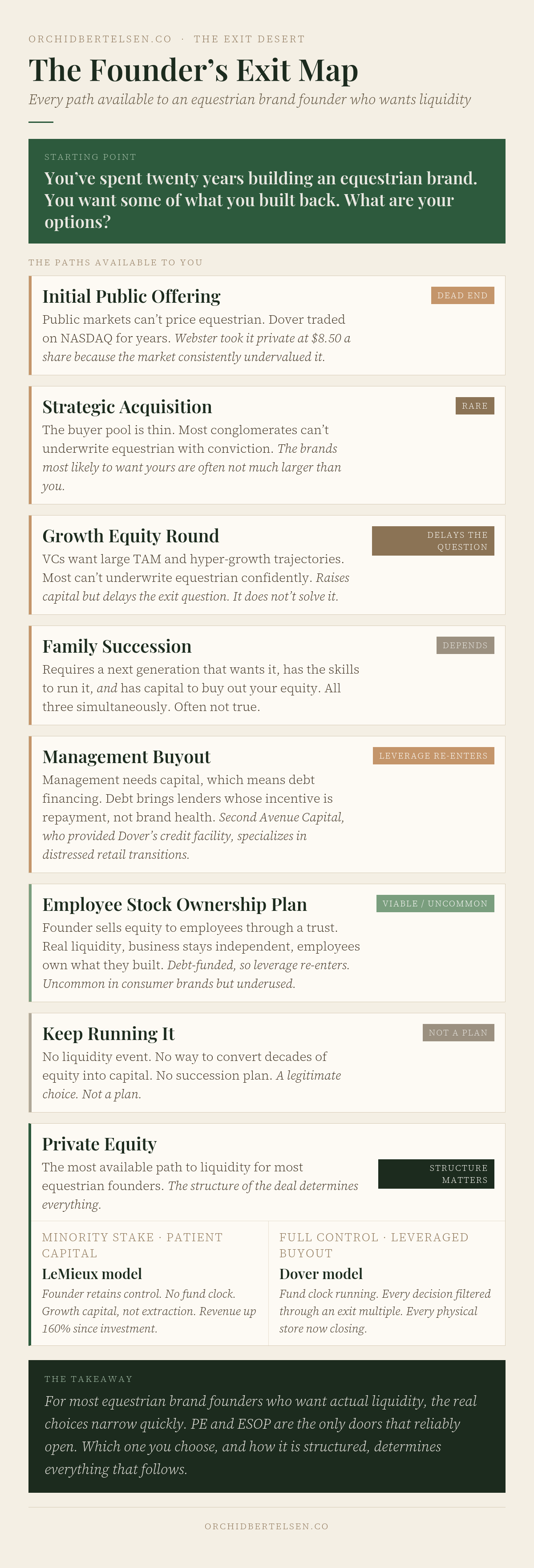
Now back to the founder with twenty years of equity in a brand. They want liquidity. Here is what their options actually look like.
An IPO. Taking a company public requires scale, predictable revenue, and an institutional investor base that understands the business. Dover Saddlery was publicly traded on NASDAQ under the ticker DOVR for years. It was the most prominent equestrian business in the United States. And the public market consistently failed to value it correctly.
Wall Street analysts covering consumer retail do not understand why a Dover customer is structurally different from a Dick’s Sporting Goods customer, or why brand trust in the equestrian community takes decades to build. The market undervalued Dover. Webster Capital took it private in 2015 at $8.50 per share in roughly a $100 million transaction.
Dover never came back to public markets.
The one equestrian-adjacent company that has succeeded as a public entity is Churchill Downs Incorporated, which reported $2.93 billion in revenue in 2025. But Churchill Downs is a gaming and entertainment company whose revenue comes from wagering, casino operations, and media rights to the Kentucky Derby. Its three business segments are Live and Historical Racing, Wagering Services and Solutions, and Gaming. Wall Street can price gambling. It can price media rights. It has demonstrated, repeatedly, that it cannot price an equestrian passion economy business.
The pattern is not random. Public markets consistently fail to price equestrian businesses because they lack the industry literacy to do it.
A strategic acquisition. A strategic buyer is a larger company that acquires a smaller one for the value of its brand, customer base, distribution channel, or technology. In most consumer categories, there are dozens of potential strategic acquirers.
In equestrian, the pool is thin. The market is niche, the customer is specific, and most consumer conglomerates do not have the internal expertise to underwrite an equestrian acquisition with conviction. The brands that might want to buy your brand are often not much larger than you are.
Growth equity. A founder could raise a round from a growth equity firm the way a consumer brand startup would. The problem specific to equestrian: most growth equity firms have the same knowledge gap as the public markets. They want large TAM and hyper-growth trajectories.
Their exit expectations, eventually an IPO or strategic sale, run into the same wall. Raises capital, but delays the exit question rather than solving it.
Family succession. Passing the business to the next generation requires a next generation that wants it, has the skills to run it, and has access to capital to buy out the founder’s equity. All three conditions have to be true simultaneously. Often they are not.
A management buyout. Management buys the founder out. This requires management to have access to capital, which usually means debt financing. And debt financing brings a lender into the capital structure whose incentive is repayment, not brand health.
The $15 million revolving credit facility Second Avenue Capital provided to Dover in August 2024 was extended by a lender that specializes in distressed retail transitions. That is the kind of lender equestrian businesses have access to. When that debt enters the structure, it comes with covenants, collateral requirements, and a senior secured position that puts the lender ahead of everyone else when cash comes in.
An ESOP. An Employee Stock Ownership Plan lets a founder sell equity to employees through a trust, creating real liquidity while keeping the business independent and giving the people running it actual ownership. The business borrows to fund the buyout, which reintroduces debt. But the incentive structure is completely different from PE: no fund clock, no external investor whose return you are optimizing for. Underused in consumer brands, but a real path.
Keep running it. For many equestrian founders, this is the actual choice: build indefinitely with no liquidity event, no way to convert decades of equity into capital, and no clear succession plan. That is a legitimate choice. It is also not a plan.
What remains, for a founder who wants actual liquidity, is private equity and the occasional strategic deal. That is a very short list.
Case Study One: LeMieux
In March 2021, LDC, the private equity arm of Lloyds Banking Group and one of the most established mid-market PE firms in the UK with 40 years of history and more than 650 investments, took a minority stake in LeMieux. Hampshire-based founders Robert and Lisa LeMieux retained majority control.
The terms of the investment were not publicly disclosed, but the structure was clear: minority stake, founder-led, growth capital. LDC’s incentive structure was meaningfully different from a traditional buyout fund. There was no leverage. There was no defined exit clock: LDC is backed by Lloyds Banking Group, which means it can hold positions patiently in ways a traditional closed-end fund cannot.
The investment thesis was amplification: fund the international expansion and professional management infrastructure that LeMieux needed to scale beyond what the founders could finance internally.
The results are in the public record. Revenue grew from approximately £22 million at the time of investment to £59.1 million in the fiscal year ended April 2025, an increase of roughly 160 percent. Headcount grew 185 percent to more than 170 employees.
International sales now represent more than 40 percent of revenue. The brand opened a flagship retail store at the World Equestrian Center in Ocala and a permanent showroom in Dallas. In May 2025 it received a Royal Warrant of Appointment from King Charles III. In December 2025 it announced a collaboration with Stella McCartney.
In 2024, LeMieux was reported to be exploring a sale at approximately £150 million, roughly $200 million at current exchange rates. No sale occurred. The asking price did not find a buyer.
A founder-led brand with 160 percent revenue growth, a Royal Warrant, operations across 69 countries, and a Stella McCartney collaboration could not close a sale at $200 million. The equestrian exit market did not produce a buyer with both the capital and the industry knowledge to pull the trigger.
LeMieux continued growing anyway. LDC stayed patient.
What made the LeMieux structure work was structural alignment, not luck. Minority stake meant the founders retained decision-making authority. Patient capital meant the investor’s incentive was growth, not extraction on a fund clock. No leverage meant the business did not carry a debt structure that prioritized repayment over investment.
Case Study Two: Dover Saddlery
Dover’s story runs in the other direction and is covered in detail in a companion piece, Not Every Story Gets a Villain. The short version for context here: full control acquisition, leveraged capital structure, fund clock running.
Every decision filtered through a return multiple and an exit timeline that had nothing to do with fifty-year retail health. Every physical store is closing. Whether the brand and its digital business survive in some form remains an open question at the time of writing.
The structural contrast with LeMieux is the argument. Same category of capital. Minority versus full control. Patient versus clocked. Founder-led versus founder-out. Growth capital versus leveraged extraction. The outcomes were not a coincidence.
What Founders Know That the Community Doesn’t
The equestrian community’s frustration with private equity is understandable. It is also directed at the wrong question.
Founders who take PE money are not being naive. They are not selling out. They are often making the only rational choice available to them in a market that offers almost no other path to liquidity. The decision to take PE capital usually comes from constraints, not options.
The community does not see those constraints because founders rarely discuss them. The terms are confidential. The negotiations are private. And there is a cultural expectation in the equestrian world that founders should be motivated by love of the sport rather than financial returns.
That makes it difficult for a founder to say publicly: I needed to convert my equity into capital and this was the only viable path to do it.
The problem is not that founders take PE money. The problem is that the incentive structures attached to that capital are frequently misaligned with what equestrian brands actually need to thrive. And that misalignment is not always visible at signing.
What the Industry Actually Needs
The LeMieux outcome points toward something. Patient capital, minority structures, founder control retained, growth orientation rather than extraction. The structure matters as much as the capital.
Building that in equestrian requires two things that do not yet exist at scale: investors with genuine equestrian market knowledge who can underwrite deals with conviction, and founders who understand the incentive structures attached to the capital they are considering before they sign.
The exit desert is a structural problem. It will not be solved quickly. But it can be named, and named clearly, and that is where the work starts.
Sources: LDC press release (March 2021); LDC portfolio case study (December 2025); LeMieux Companies House filings; Worcester Business Journal, Dover Saddlery going-private transaction (2015); The Plaid Horse, Promus acquisition announcement (April 2022); Boston Globe, Prudential lending arm report; Horse & Hound / Everything Horse UK, LeMieux sale process (March 2024).
Orchid Bertelsen is an equestrian industry analyst and consumer marketing strategist with 20 years of experience in e-commerce and brand strategy. She rides at Grosse Pointe Equestrian in Michigan.
I love this breakdown! I work at a PE backed company and even I learned more about how PE works. Thank you!