The US Equestrian Market Has a Retail Gap. Here's How It Got There.
No Target. No Walmart. No overnight. Just Dover, or a tack shop with three locations.

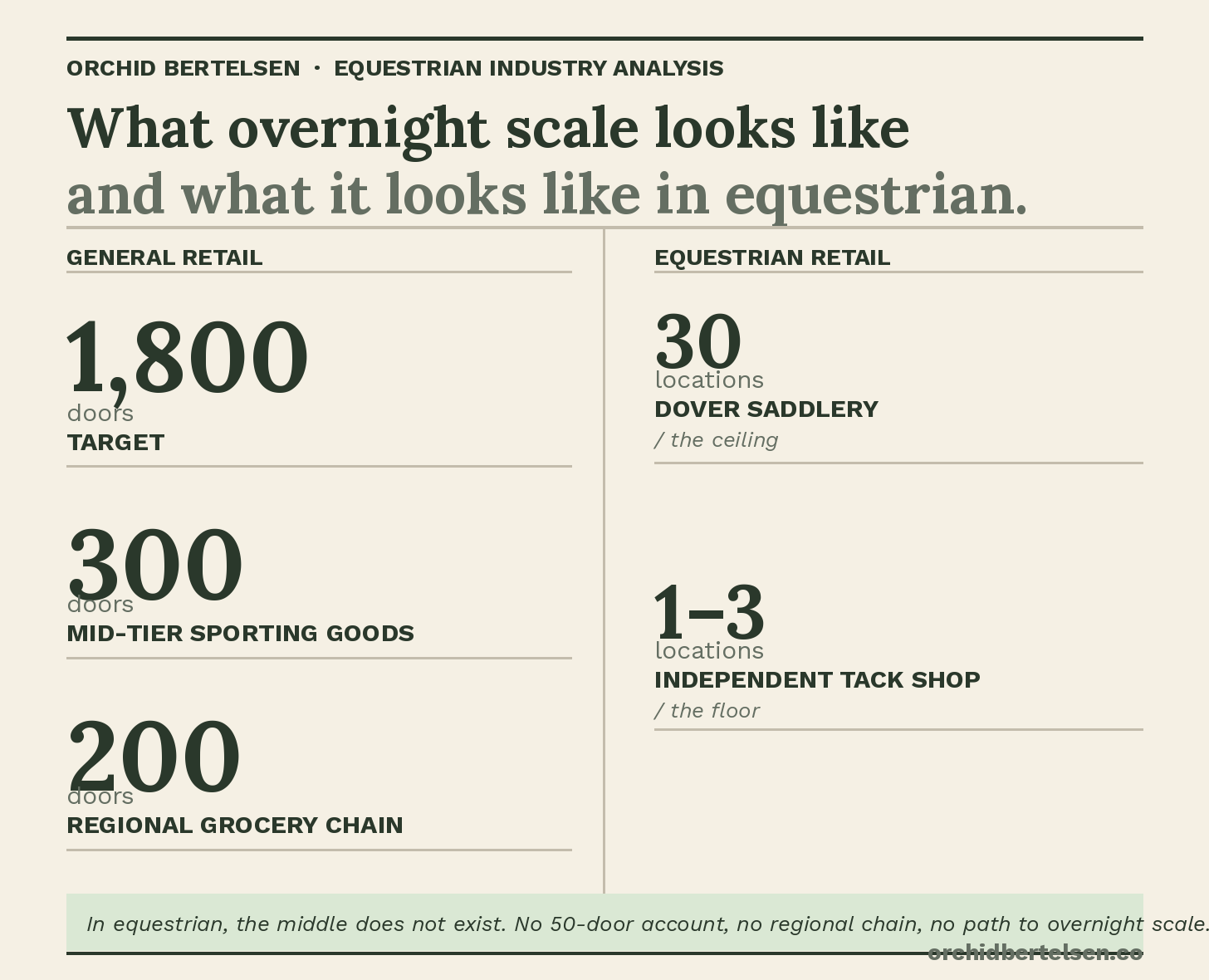
If you are a brand trying to scale distribution in the US equestrian market, here is your reality: your biggest wholesale account is Dover Saddlery, with roughly 30 locations and an estimated $158 million in annual revenue. After that, you are calling on independent tack shops, most of which have one to three locations, no shared inventory system, no common data infrastructure, and no meaningful ability to move volume overnight.
That is the entire landscape.
In most consumer categories, a brand with real momentum can walk into a Target buyer meeting and come out with 1,800 doors. A regional grocery chain is 200 locations. A mid-tier sporting goods account is 300. Scale exists as a structural feature of the market. You can access it if your product qualifies.
In equestrian, that infrastructure does not exist. It never has.
How the Ceiling Got Built
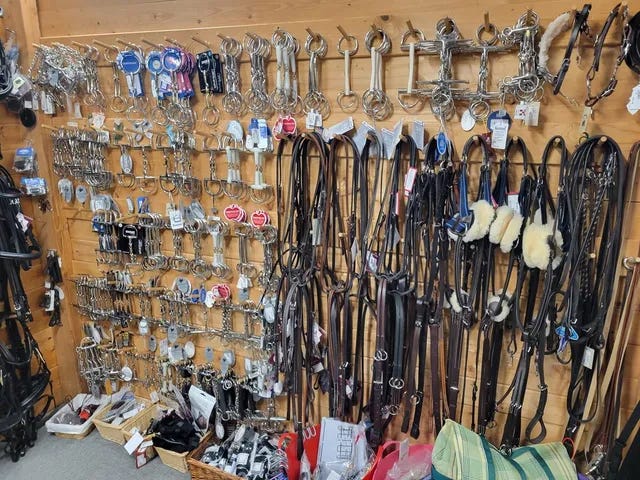
The independent tack shop is the backbone of equestrian retail in the United States. There are hundreds of them. They are run by riders, staffed by riders, and trusted by riders in ways that no corporate retailer has ever managed to replicate. That is genuinely valuable.
But each one is an island.
There is no common point-of-sale system connecting them. No shared inventory data. No cooperative buying structure that would let a brand negotiate terms against meaningful aggregate volume. No clearinghouse that tells a wholesaler which shops are turning product and which are sitting on dead stock. Every account is a separate relationship, a separate negotiation, a separate reorder conversation.
For a brand trying to build a wholesale strategy, this means the independent channel is real but slow. You are adding one shop at a time, often through trade show relationships and personal outreach, with no ability to compress the timeline. A brand that spends three years building 80 independent tack shop accounts may still be moving less volume than a single mid-size Dover order.
The result is a market where wholesale scale effectively has one address. And that concentration creates its own set of risks.
The Amazon Problem
Amazon didn’t fill the equestrian retail gap. It made the gap harder to fill.
For independent tack shops, Amazon has become the default channel for anything a rider can buy without touching it first: fly spray, supplements, basic grooming supplies, stable hardware. The commodity layer of the business that used to generate consistent foot traffic and basket-building has quietly migrated to Prime delivery. The shops still open their doors, but they’re competing on the items where Amazon has the most leverage: price, convenience, and two-day shipping.
What Amazon cannot do is replace the specialist. It cannot tell you whether a bit is right for your horse’s mouth. It cannot fit a saddle. It cannot stock the specific brand a trainer requires and explain why. The high-consideration, expertise-dependent purchases still need a human. But that human now works at a shop that has lost the easy revenue that used to subsidize the expertise.
The result is a bifurcated market. Amazon owns the low end. Dover and the surviving independents compete for the high end. The middle, the accessible, well-stocked, knowledgeable retailer a rider could browse without a specific purchase in mind, has no owner.
That is not Amazon’s fault. It is a structural condition Amazon accelerated. We will cover Amazon another time as it deserves its own space.
The Cautionary Tale
State Line Tack was, for decades, the largest equestrian retailer in American history. The flagship in Plaistow, New Hampshire was a four-story converted barn that held the largest selection of horse supplies under one roof in the country. Riders drove hours to shop there. The catalog was a reference document. The brand meant something.
In the mid-2000s, PetSmart acquired State Line Tack and built equine departments into 160+ store locations. On paper it looked like scale. In practice, equestrian represented less than 2% of a $4.23 billion company’s revenue. The category got deprioritized, then ignored, then shut down.
The Plaistow barn is still there. It is now a Dover Saddlery.
State Line Tack didn’t fail. It got absorbed by an acquirer that had no structural reason to care about the equestrian customer, and when the category stopped being convenient, it disappeared. The brands that depended on it for distribution had nowhere to go except Dover, which was the only credible option left standing.
That is what retailer concentration looks like when the dominant player exits. One decision by one acquirer, and the distribution channel for an entire category collapses.
Dover today is a different company facing different pressures. [If you want to understand where Dover’s ownership structure is headed and what it signals for the brands on its shelf, that analysis is here.] The point for this article is simpler: when Dover is your ceiling and your floor, you are exposed in ways that brands in other categories are not.
What the Gap Actually Looks Like
The US equestrian equipment market generated $3.8 billion in revenue in 2024, per Global Market Insights. The customer base is 92.6% female, according to American Horse Council demographics data.
This is a customer with money, with deep category loyalty, and with a demonstrated willingness to pay for quality. She is also chronically underserved by the retail infrastructure built around her.
The DTC brands are starting to prove the demand exists on its own terms. Free Ride Equestrian and Sync Equestrian both built direct, own their customer data, and are compounding without Dover. They are not yet at scale, but they are proof of concept: a rider with an Instagram following and a Shopify store can build a real business without ever touching the traditional wholesale channel.
What does not exist is the middle. The multi-door, physically present, category-expert retailer that a brand can grow into. The account that could be 50 doors today and 200 in three years. The retail partner with the operational infrastructure to actually move volume and the category knowledge to merchandise it correctly.
That company has never been built in the United States.
The Gap Is Visible From Outside
PADD has operated as France’s dominant equestrian retailer since 1974. Roughly 100 stores, a flagship on Boulevard Haussmann two steps from the Champs-Elysées, mobile trucks that travel to clubs and shows, and an active franchise expansion program targeting 25 additional locations in the next three years. They carry 12,000 products and run a national loyalty program. They are, in short, the thing this market has never had: a retailer built specifically around the horse person, at real scale, with the infrastructure to grow.
Greenhawk, Canada’s largest equestrian retailer with 50+ stores and 40 years of operating history, launched a US e-commerce platform in May 2025 and opened a physical location in Natick, Massachusetts. CEO Ian Russell was straightforward about the rationale: the US customer is there.
Neither of these companies is American.
This is not a winner-take-all market. The US is too large and too geographically dispersed for any single player to own it quickly. But there is real share available, and the fragmentation that has defined US equestrian retail for decades is not a permanent condition. It is an infrastructure problem. Infrastructure problems get solved when someone decides the market is worth building for.
The independent tack shop landscape is too fragmented to aggregate on its own. The one dominant retailer is under financial pressure. The DTC brands are proving demand exists but cannot provide physical retail presence. And the companies that have actually solved the multi-door equestrian retail problem are not American. They are just starting to pay attention to the market that hasn’t been served.
A Note on the Numbers: Revenue figures for Free Ride Equestrian and Sync Equestrian are Particl estimates derived from e-commerce transaction data and are not audited. The $158M Dover revenue figure is from company press materials. The $3.8B US equestrian equipment market figure is from Global Market Insightsand should be treated as directional. The 92.6% female horse ownership figure is from American Horse Council survey data. Where primary sources are available, they are linked inline.
Orchid Bertelsen is an equestrian industry analyst and consumer marketing strategist with 20 years of experience in e-commerce and brand strategy. She rides at Grosse Pointe Equestrian in Michigan.
Really like this
Let’s talk about the purveyors of equestrian supplies who are absolute thieves, grifters and all-around shits. I am looking at you, Lyndsey White, repping Fager Bits USA and Artemis Equine bridles, at admin@eliteequestriansupply.com
sales@eliteequestriansupply.com
When Lyndsey steals commissions from double-digit numbers of professional bit & bridle fitters on the Team, it makes it hard to trust ANY equestrian suppliers. And that screws the Riders and most importantly, the Horses.
Feel free to contact me for more details.